Dates
Overview
In alliance with SMITHSONIAN JOURNEYS, PONANT discover Panama and Costa Rica on this splendid 8-day cruise aboard Le Champlain, which explores the region’s abundant natural splendors, local indigenous communities, and the modern marvel of the Panama Canal. This cruise is part of a collection of PONANT voyages that are specially tailored for English-speaking travelers who want to engage with the world. In addition to the usual elements of the PONANT experience, the listed price for these voyages includes transfers to and from the ship, talks and discussions aboard ship by world-class experts, and a shore excursion or activity in each port of call that encourages guests to embrace the sights, sounds, tastes, and smells of the local environment and culture.
Expedition Highlights
- A voyage specially tailored for English-speaking travelers including discussions with experts, transfers before and after your cruise, and an included excursion or activity in each port of call.
- Engaging discussions onboard with two Smithsonian Journeys Experts.
- A specially arranged visit to the Punta Culebra Nature Center at the Smithsonian Tropical Research Institute (STRI), guided by Smithsonian staff.
- Opportunity to swim and snorkel on beautiful Holandes Cayes, one of the magnificent islets of the San Blas Islands.
- A daytime crossing of the Panama Canal, a true masterpiece of civil engineering.
- The UNESCO World Heritage Darién National Park and its magnificent rainforest.
- An exploration of the region’s rich and myriad tropical flora and fauna in Manuel Antonio National Park.
- Encounters with the local indigenous Kuna and Emberá communities.
Itinerary
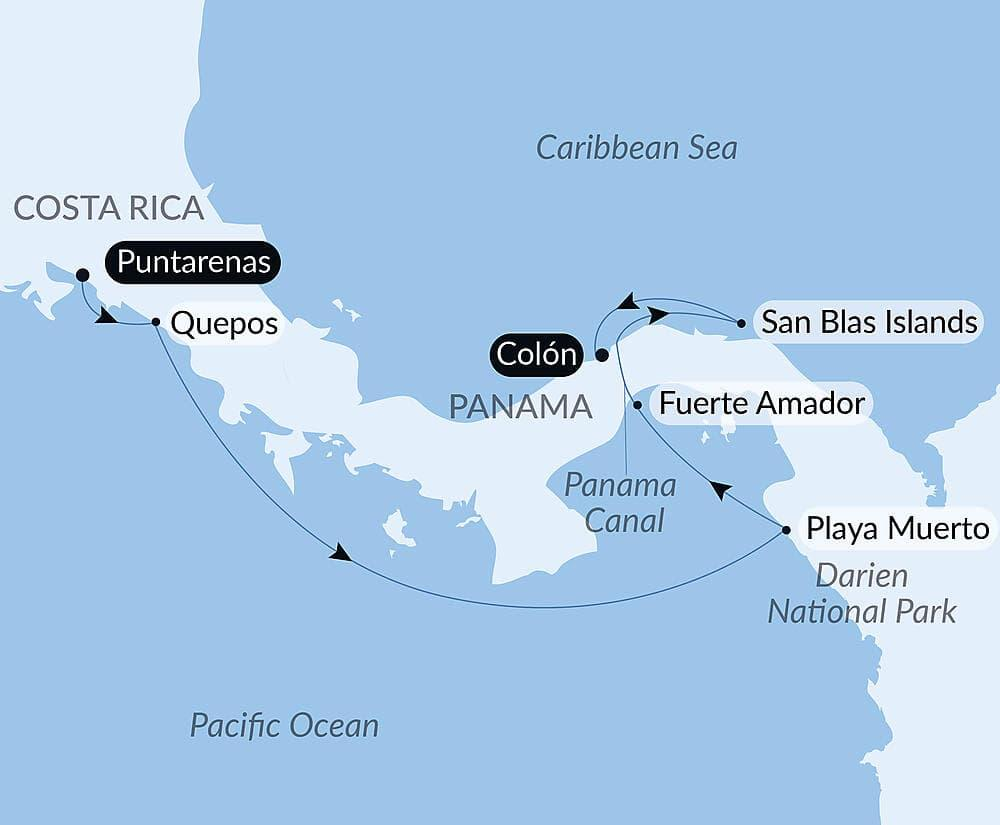
Day 1 – Colón, Panama
Embarkation from 4:00 PM to 5:00 PM
Departure at 8:00 PM
Colón is the second largest city in Panama, at the Caribbean entrance of the Panama Canal. Colón is today an important port, and the free trade zone created in 1953 contributed greatly to the development of the city. Colón was founded in 1850 by Americans working on the Panama railroad connecting the Atlantic and Pacific coasts through the Isthmus of Panama; the city rapidly overshadowed the older Caribbean ports of Panama when the canal opened.
Day 2 – San Blas Islands, Panama
Located on the northeast coast of Panama, the San Blas Archipelago is a string of coral islands in the heart of the Caribbean Sea. More than 300 islands and cays cover an area of 300 square kilometers offering travelers a multitude of treasures. Sheltered behind a long coral reef, the San Blas Islands are full of enchanting anchorages. The long sandy white beaches bound by crystal-clear waters will allow you to relax and enjoy incredible marine fauna before engaging with the Kuna Indian community. Still subsisting on hunting and fishing, they will welcome you in their villages of bamboo houses gathered near the beaches.
Day 3 – Crossing the Panama Canal
Aboard your ship, experience something unique that has inspired the imagination of numerous adventurers in the 20th century: sailing the Panama Canal. Its construction started in 1880 under the direction of Ferdinand de Lesseps. Abandoned then resumed, this marvel of engineering was completed by the United States and opened in 1914. The canal crosses the Isthmus of Panama and links the Atlantic to the Pacific. Including three levels of locks and by raising ships to the level of Lake Gatun, almost as if the water was a lift, it allows them to avoid having to round Cape Horn.
Day 4 – Playa Muerto, Darién National Park, Panama
The most remote and least developed region of Panama, the province of Darién is an unspoiled land with an extremely rich variety of flora and fauna. Listed by UNESCO as World Heritage, Darién National Park offers extraordinary scenery of rocky coastlines, mountain ranges, mangroves, rivers and creeks. Discover Playa Muerto, a tiny coastal village home to the Emberá Amerindian community. You will visit the village, attend traditional song and dance performances, and admire beautiful local craft.
Day 5 – Fuerte Amador, Flamenco Island
An artificial peninsula situated at the Pacific entrance to the Panama Canal, Fuerte Amador is the gateway to several noteworthy sites. Right near there, the impressive Miraflores Locks are a shining example of the engineering feats deployed during the construction of the Panama Canal. Further north, in villages nestling amid dense vegetation, lives the Emberá tribe, guardian of the forest and of the Chagres River. This proud people have successfully preserved their traditions and their ancestral way of life, which predate the colonization of the region by the Spanish.
Day 6 – At Sea
Day 7 – Quepos, Costa Rica
Quepos makes for a charming stop-off on the Pacific coast, just next door to the famous Manuel Antonio National Park, an untouched tropical natural reserve lined with white sandy beaches. The town’s seafront is an opportunity to stroll through market stalls touting pineapples and bananas in the shade of the manchineel trees. In this coastal town crisscrossed with tree-lined streets in bloom, admire the houses and their incredible sculpted balconies. Enjoy a spot of shopping in the many traditional boutiques: pick up some handmade cotton clothing, ceramics embellished with Costa Rican designs and home décor pieces in hand-painted wood.
Day 8 – Puntarenas, Costa Rica
Disembarkation at 8:00 AM
The capital of the eponymous province, Puntarenas is sometimes called “the pearl of the Pacific” for its unique charm. It sits on the Pacific coast of Costa Rica, along the Gulf of Nicoya, lined with long expanses of wild natural environments. Further inland, among the countless natural wonders to be found in the generous rainforest of Costa Rica’s national parks, Poás and Arenal volcanoes tower up in all their majestic glory. In this luxuriant natural setting, Costa Rica protects one of the planet’s richest biodiversities: monkeys, sloths, tropical birds, iguanas, crocodiles, waterfalls, canyons, and more than ten thousand species of tropical plants.